"History isn’t a myth-making discipline, it’s a myth-busting discipline ..."

Sir Richard Evans FBA

Saturday, December 10, 2022


Friday, May 20, 2022

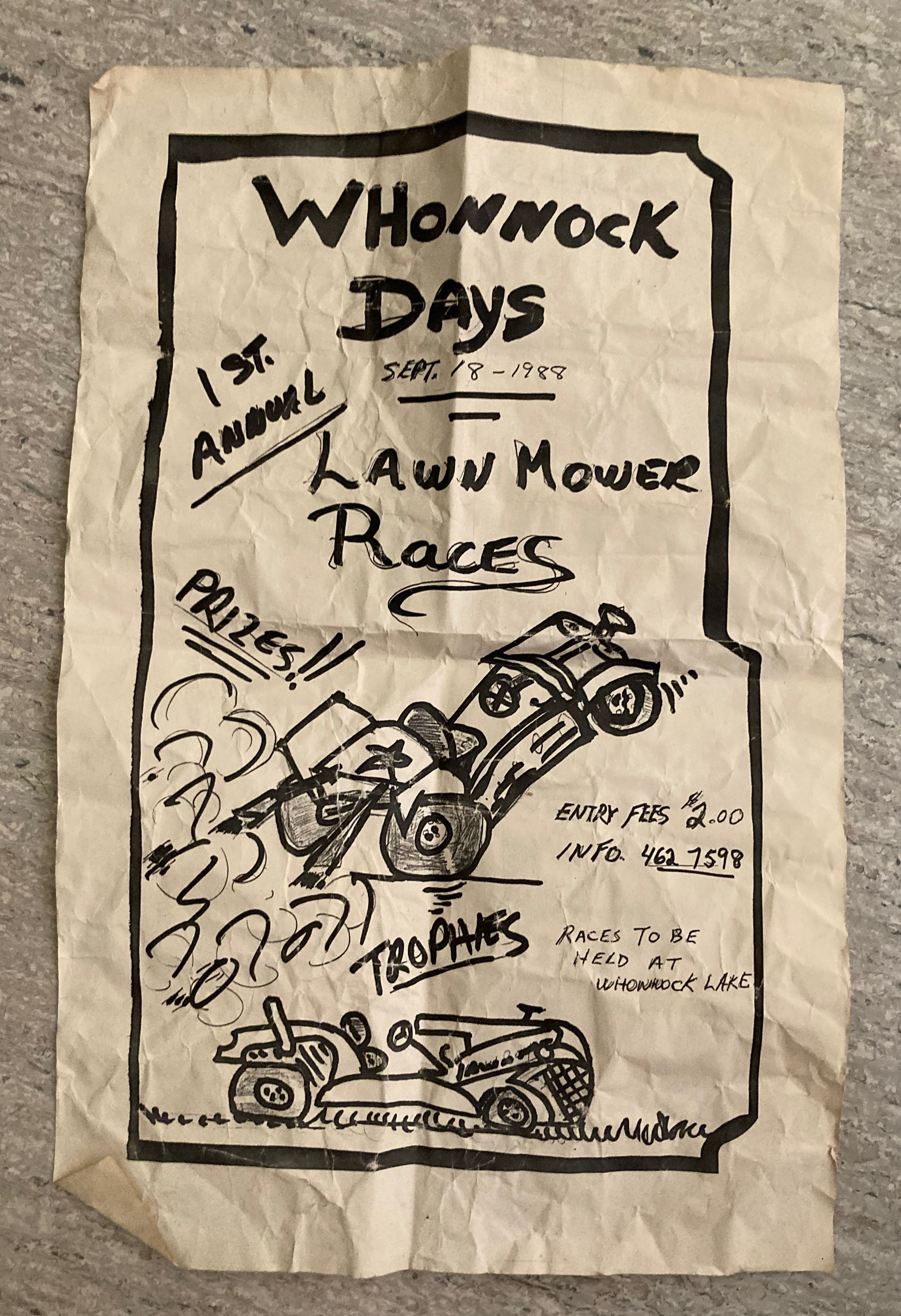
Lawn Mower Races


This small poster was kindly donated to the Whonnock Archives by Dorothy Gallagher who found it in Stanley Matthew’s former house. “Whonnock Days” or “Whonnock Day” was an annual event organized by the Whonnock Community Association since 1982. The lawnmower race continued to be part of it after 1988. 

Thursday, April 28, 2022

Maple Ridge – A History of Settlement

Maple Ridge – A History of Settlement was published in 1972 and the last printing was in 1989. 
Some of us seem to believe that the 1989 printing still sold today is an update from the original. Let there be no mistake: a list with a dozen or so “corrections and supplements” was added in 1975 but otherwise the content has not changed. It is still the same as that of the original of half a century ago. 
Based largely on memory rather than contemporary records  -- hard to access in those days -- the book is an interesting mix of myth and historical facts. It has been in need for a major rewrite for decades.


Wednesday, February 16, 2022

Ruskin Church

Ruskin Baptist Church - Photo by Bob Sheridan ca. 1972

In the summer of 1942 the Mennonite South Abbotsford  Church conducted a summer Bible school at Ruskin and 1943 started a Sunday school. In 1949 the South Abbotsford Church in combination with believers in Ruskin erected the “Ruskin Gospel Chapel” they dedicated on 11 September that year. 

In 1957 there is a handover to a Baptist group – probably associated with Mission rather than Maple Ridge. Services were probably held by visiting clergymen until 1971when John Gilchrist became pastor of the Ruskin Baptist Church. (He was not related to the pioneer family with that name). 

From 1977 the church was home of the Ruskin Gospel Church (pastor Jim Poelzer) who on his retirement in 2007 donated the church to the Maple Ridge Foursquare Church (pastors Pastor Les and Linda Warriner).

Thanks to everyone who helped me find traces of past. 


Saturday, January 8, 2022

FIRS Ltd.


1922 - Mrs. Jane Hamilton Pullen on the frozen Fraser River at Whonnock.
Maple Ridge Museum and Archives 

On the north shore behind Mrs. Pullen is a sawmill. Note the log ramp. This mill is probably FIRS Ltd., a sawmill listed in Wrigley’s B.C. Directory from 1919 to 1923. After the First War, Japanese settlers started clearing the higher levels of Thornhill for farming. What now is 263rd Street was once a skid way were teams of horses pulled logs cut by the Japanese to a landing on the riverbank. That is where FIRS Ltd. stood.  
It is not known who the owners of this mill were. The company was apparently not incorporated in spite of that “Ltd.” The mill’s manager was Charles Francis Wilcox, born in Haney. Were the owners Japanese? 
The next sawmill in Whonnock shown in the directory of 1926 was WHONNOCK LOGGING, incorporated a few years later as WHONNOCK LUMBER MILL LTD. by Zentaro Shin and partners. A succession of other mill owners followed over time at this location up to the present day. 

Tuesday, November 16, 2021

Thursday, October 7, 2021

Anglican Church, 1957

Left behind the church, on what is now a parking lot, is the old church hall. To the right, behind the church, the vicarage. 


Anglican Church


Detail from an 1948 photo of Whonnock's "downtown" showing what was then called St. John the Evangelist. Note the old church hall above the church on what is now the parking lot. To the east the vicarage -- long gone. In front, in the left-hand corner of the picture is Henk Lee's house, 27090 River Rd,

Air photo taken at the time of the Fraser flood. 

Thursday, June 17, 2021


In 2021 the parishioners of the Holy Spirit Anglican Church in Whonnock will celebrate the centennial of the birth of their church on River Road. 

The precursor of the present church was St. Paul’s on 272nd Street, built in 1891. 

Already as early as 1909 the parishioners of this “English Church” wanted to build a new church once the necessary funds were collected. In 1913 they purchased the land but the First World War put their plans on hold.

Finally, in 1921, they built the new church, dedicated to St. John the Evangelist. It still stands there a century later. 

This little book might be of particular interest to the members of the Anglican Church, but anyone interested in Whonnock’s history will enjoy reading about St. Paul’s Church and its people.

Friday, August 21, 2020

Red & White Store


Ted and Rusty Ming and their son Wayne. 

The Ming family owned the Red and White store from 1956 to 1967

Tuesday, July 7, 2020

Whonnock Lake -- a natural lake

Whonnock Lake is not as Wikipedia says, a man-made lake. 
It is a natural muskeg lake and, if left alone, it will slowly turn into a peat marsh.The only regular water input is from the north. There is an exit to Whonnock Creek on the south-east side originally closed off by a sandbar (beaver dam) that was replaced in 2008 by a man-made berm and fish channel. This is where the water escapes from the lake to Whonnock Creek. 
In the past beavers regulated the water level of the lake — now the city does that.

Saturday, May 2, 2020

Notes about MacBryer property

About the property on the south side of 96th Avenue between 272nd Street and the cemetery.

The original house was probably built ca. 1920 by carpenter Alexander Thomson MacBryer (or McBryer) for himself, his wife Helen and three sons Alexander Ainslie, George and William.

Alexander Sr., was born in Scotland and migrated in 1910 to Manitoba with his first wife Catherine and their newborn son Alexander Jr.  Catherine died in 1911.

In 1912 Alex Sr. married Helen. In November 1914 Alex Sr. joined the Canadian Expeditionary Force. The family then lived in Vancouver where son George was born in 1915. Not certain when and where William was born.

After the Fist World War ended the family moved to Whonnock where they lived until 1958 when the couple and son William moved to a place near Gibson. By that time Alexander Jr, and George had moved away. AT drowned near Gibson in 1961. Helen died in 1964 in Vancouver, George died in a plane crash near Alert Bay in 1966. Alex Jr. in Maple Ridge in 1989. William also rests at the Maple Ridge cemetery.

Sunday, March 22, 2020

Plan to wreck a train

Vancouver Sun, 17 December 1912

Wednesday, October 2, 2019

Looking Back

This new book containing a collection of Fred's contributions about the past of Whonnock and Ruskin to the "Looking Back" column of the Maple Ridge News, is for sale at the Whonnock post office.
5.5 x 8.5 inches, 170 pages.

REPRINTED BY POPULAR DEMAND
For sale at Black Bond Books, Valley Fair Mall, Maple Ridge

Saturday, February 16, 2019

Forest fires

From the MR Museum and Archives a map showing the location and years of the forest fires from  1919 to 1987. Click on image to enlarge.

Monday, January 21, 2019

Heritage Resources

This is a wonderful updated version of the 1998 Heritage Inventory. 
Of interested to anyone who wants to know more of the remnants of the past all around us. Click here. 

Friday, January 11, 2019

Bell of St Paul’s now at Holy Spirit Anglican Church

On page 49 of Maple Ridge: A History of Settlement you’ll read of the (1912) improvement of the church “… by the handsome gift of a bell and belfry from the Percys….” 
Those Percys were Mary Anne (Legge) Percy (1840 – 1926) and three of her children: her daughter Ethel Langfield 1870 – 1951) and sons Percy Hugh Jocelyn (1867 – 1951) and Harry Alfred Reginald (1874 – 1962).  Mary Anne Percy was the widow of the Rev. William John Edward Percy, who died in 1876. 
The Percys came from Devon. Harry was the first to land in Canada in 1896, followed by the others in 1897. As from 1896 they were the taxpayers/owners of a quarter section (160 acres) along the west side of 272nd Street above 104th Avenue.
The Percys are all buried in the Fraser Cemetery in New Westminster. 

Monday, March 13, 2017

War Dead WW II

There is no list of those from Whonnock and Ruskin who lost their lives in the Second World War. So far I have only been able to collect the names of four from Whonnock who died in the 1940s. If you happen to know someone else not listed here please let me know:

Derwood William SMITH, 1917-1944 
Leonard Allan SCUTT, 1923-1944
Reginald Frank WILLIAMS, c 1920-1943
Mervin Clayton BOND, 1923-1944
Edward Alan SPROULE, 1919-1943

Sunday, December 4, 2016

School Bus 1946

THE WHONNOCK BUS

Riding down to Haney
We ride the Whonnock “Flier,”
No running boards, no headlights,
No motor and no tires;
No motor and no spark
Still less co-operation.
The bus won’t use good gas and oil
It runs on reputation.
We have to ride this relic
Five days in every week.
We can have a seat but prefer to stand,
It’s safer so to speak.
The seats of lath and slivers,
Are frightful to behold;
The chick-wire windows let in drafts
And boy! It’s really cold.
Long may its rust spots glitter
Long may its motor cease
Long may it run the “Junk Heap Trail”
Then forever rest in peace.


Vera Hodson 1946

Saturday, December 3, 2016

Robbery at Ruskin

It is generally believed that in 1904 Billy Miner robbed the CPR train at Silverdale and that this happened right in front of the Donatelli house at the end of today’s Donatelli Avenue. According to one story, Mrs. Donatelli  pushed the children away from the windows because she saw that the men had guns. A more exotic version tells us that she pushed the children to the floor when shots rang out. 

A newly discovered interview with Nat Scott, the train engineer of the ill-fated train, contradicts that story. Since the engineer was right there when it happened and the interview was held immediately after the train arrived in Vancouver that night the article must surely be given more credence that any other accounts of the incident. The engineer was told to stop the train first at a place out of sight of the Donatelli home, There they left the passenger cars. Then the train moved on to Ruskin where the actual robbery took place. 

Click here to read a transcript of the article about the interview published in Daily Colonist of 13 September 1904. 

Click here for the story as published on The Ormsby Review. 


Below is a copy of a map shown in the book Interred with Their Bones, Bill Miner in Canada, by the late Peter Grauer, self-published in 2006. (1) Silver Creek, shown on the map as the place where the passenger coaches were left, is actually named Jamieson Creek. The bridge across Jamieson Creek would have been where today McLean Street crosses the rail tracks. Silver Creek was the original name of today’s Silverdale Creek close to Mission and far from Silverdale. (2) The actual looting took place near Heaps mill in Ruskin. (3) From Ruskin, without any wagons attached, the engine sped away to Whonnock. Bill Miner and his friends were dropped off at “the creek just this side of Whonnock siding.” That was at Cook Creek, right at the Whonnock wharf. There they “borrowed” a rowboat to cross the Fraser and vanished in the night.